
Services
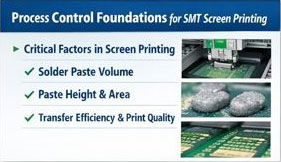
MODULE 1 — Process Control Foundations (SMT Focused)
1.1 Why Screen Printing Needs SPC & DOE
- Screen printing as the primary SMT yield driver
- Relationship between paste volume variation and defects
- Why inspection ≠ control
1.2 Key Screen Printing CTQs
- Solder paste volume
- Paste height & area
- Transfer efficiency
- Print definition
1.3 Data Sources
- SPI measurement data
- Pad-level vs component-level data
- Sampling strategy
MODULE 2 — SPC for Solder Paste Deposition
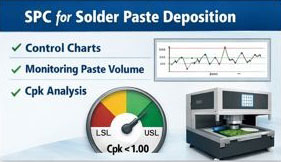
2.1 SPC Concepts (Practical)
- Common vs special cause variation
- Control limits vs specification limits
- Subgrouping for SMT data
2.2 Control Charts for Screen Printing
- X-bar & R charts (paste volume)
- I-MR charts (low volume / NPI)
- Attribute charts (print defects)
2.3 Using SPI Data in SPC
- Volume vs height vs area
- Chart interpretation
- Reaction plans for out-of-control conditions
MODULE 3 — Process Capability (Cp / Cpk) Using SPI Data
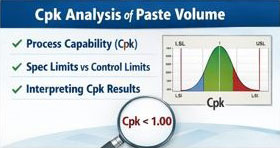
3.1 Understanding Cp & Cpk
- Cp vs Cpk in manufacturing terms
- Why Cpk matters more than yield
3.2 Cpk Analysis for Paste Volume
- Defining volume specifications
- Calculating Cpk from SPI data
- Interpreting low Cpk causes
3.3 Using Cpk to Drive Action
- Printer setup adjustments
- Stencil design changes
- Paste or coating decisions
MODULE 4 — DOE for Screen Printing Optimization
4.1 Why DOE (Not Trial-and-Error)
- Confounding effects
- Interaction between print parameters
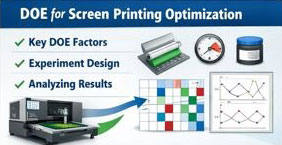
4.2 Screen Printing DOE Factors
- Squeegee speed
- Squeegee pressure
- Separation (release) speed
- Stencil thickness / coating
- Solder paste type
4.3 DOE Responses
- Paste volume
- Volume variation (σ)
- Transfer efficiency
- Cpk improvement
MODULE 5 — DOE Execution, Analysis & Control Integration
5.1 Running a Practical DOE
- Screening vs factorial DOE
- Data collection via SPI
- Randomization & replication
5.2 DOE Analysis
- Main effects plots
- Interaction plots
- Identifying significant factors
5.3 Locking in Gains with SPC
- Optimized process window
- Updating control limits
- Sustaining Cpk improvement over time
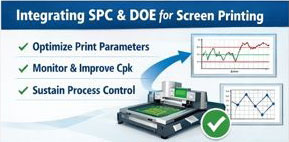
Outcome of the Course
After this training, engineers can:
- Monitor screen printing using SPC
- Quantify print performance using Cpk
- Use DOE to identify significant print parameters
- Reduce paste variation and defects
- Sustain improvements using SPI-driven control